
The Bourdelle Museum wins second La Reliure du Limousin
The second La Reliure du Limousin prize was awarded during the latest edition of the Salon du Patrimoine heritage fair. The winning entry was a collection of Danish hymns printed in 1722, bequeathed to the Bourdelle Museum by Michel Dufet, son-in-law of sculptor Emile Antoine Bourdelle.

A work in contrasting condition
Printed on laid paper in Gothic type, the bookblock entitled “Den Forordneke Kirfe Psalmebog” consists of 420 very dusty leaves, which have probably suffered damage as a result of a fire, as evidenced by the dirt and soot deposits on the edges. Many corners are dog-eared and there are a few gaps on the fore-edge, due to oxidation of the clasp in contact with the paper. Due to a shrunken and curved spine, the first and last signatures are open at the gutter, and the central signatures are slightly chipped at the edges. Despite this damage, the bookblock remains in generally good condition—in fact, complete disassembly will not be necessary during restoration.

However, two features attract our attention: unexplained double pagination and missing endpapers, the remains of which can be seen in the form of tabs.
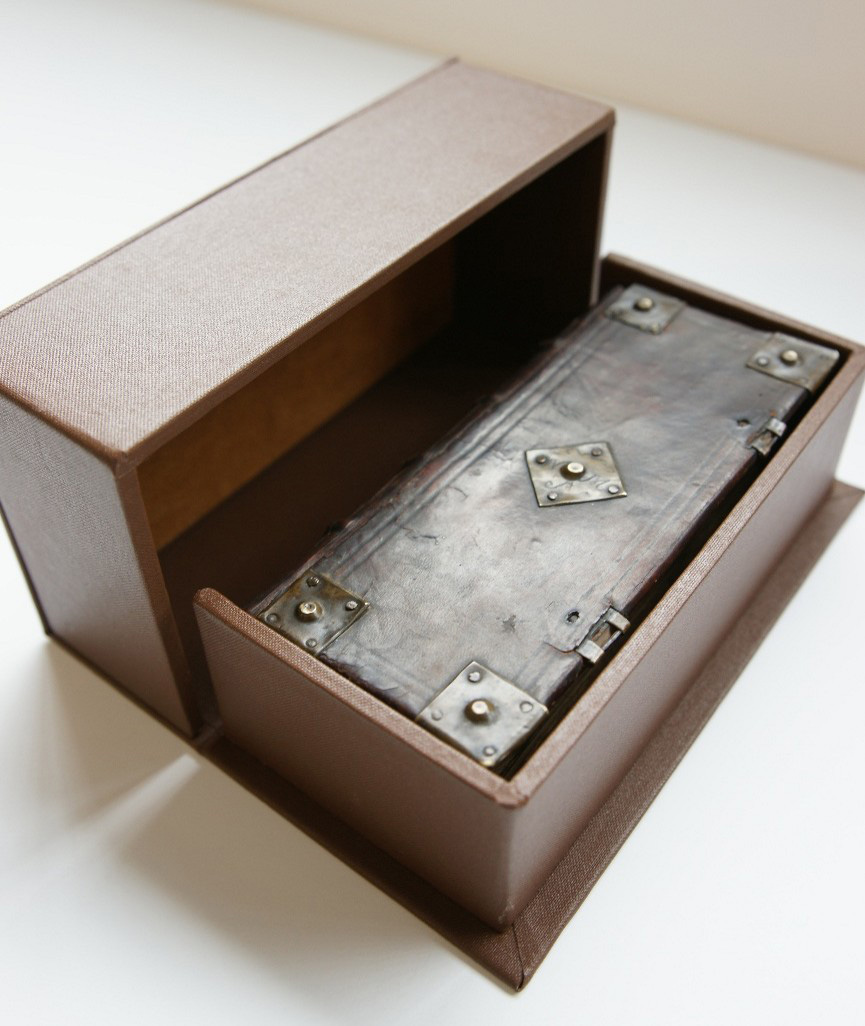
The absence of the endpapers reveals the wooden boards of the binding. The binding, which is medieval in style, consists of brown full leather marked with metal pieces in place of cabochons, namely at the corners and centers of the covers. The umbilicus (the central element) of the front cover bears the date “1799,” which is the potential date of the binding. Unlike the body of the book, it is in poor condition: moisture stains have caused discoloration and partial detachment of the leather, the pins securing the central metal pieces are oxidized, the headbands are missing, and the spine is completely cracked. Although the binding was originally attached to the body of the book using strings glued to the wooden boards, these are broken at the front joint, and the leather detached from the body of the book has a split at this point. The gutter clasps have disappeared, leaving only traces of oxidation on the edge.

Restoration without disassembling the signatures
After carefully disassembling the cover, the book is thoroughly cleaned using soft-bristled brushes and non-abrasive erasers for the edges of the pages. Any remaining glue residue on the spine is removed.
Given the double pagination already present, our restorer was able to work without adding a new number to each leaf and finished separating the signatures with broken seams and broken gutters without fear of mixing up the order of the leaves. These are then lined with 3.5 gsm Japanese paper, while the gaps are filled with 29 gsm Japanese paper. The entire process is carried out using Klucel G, which is a neutral and reversible adhesive, as recommended by the authorities in paper restoration (Archives de France, ECCO).

The challenges of digitization
Like other documents restored in our workshop, this collection is digitized at 600 dpi after the restoration of the bookblock and before sewing. However, this task proves to be relatively difficult due to the decision not to disassembling the book, which sometimes makes the writing at the gutter of the signatures inaccessible. Our digitization team therefore has to be resourceful and patient when digitizing this unique register on Copybook. Among the technical adaptations adopted, neutral dividers are inserted between the pages to avoid residual shadows and camera defects.
A binding to be refurbished

Once the book has been brought back to the restoration workshop, the sewing supports are doubled using a fine hemp string that is held in place on the original leather bands using a linen thread weave passed between the bands and the spine of the signatures. Thanks to this consolidation, the detached signatures can be sewn back onto the bookblock.

Following this key step, the book is placed in a vice to be re-rounded, a necessary step to restore the book to its original shape. The spine is then coated with methylcellulose to soften it, then reshaped by hand, and this process is repeated until a nice round shape is achieved.

Given the structure of the book and the tight stitching, a lining is added: 65 g Japanese paper is inserted between the stitching supports to ensure that the spine retains its shape. This additional material also creates a “border” between the leather binding and the body of the book, providing better protection for the latter.

The leather binding is then cleaned, treated, and waxed. However, it is necessary to “open” it, i.e., detach the spine part from the board parts, as the book has regained volume during the various operations. It therefore no longer fits into its original cover.
In order to rebuild the binding, it is necessary to add restoration leather, dyed calfskin, which our restorer must attach to the wooden boards. However, the corner pieces on the spine side block access, so it is decided to remove them. Despite their appearance, we are surprised to discover that they are not nailed to the boards, like the umbilical cord, but simply embedded. Once the leather has been added, they simply need to be put back in their exact place to ensure they are securely held in place.
The raised bands on the spine of the book are then crimped onto the restoration leather, and the original spine and hinges are reattached identically with starch glue.


As the various missing parts were not recreated, no clasp, headband or endpaper was added. For this reason, it is still possible to see the wood of the boards when the book is opened.
The final case

In order to protect this work, a custom-made box with a fixed lid was created. A veritable jewellery case, it is made of neutral cardboard, brown buckram cloth, and camel-colored suede on the inside, on the bottom. Preserved in this way, the Danish hymnbook will be able to stand the test of time.