
1st La Reliure du Limousin prize: Restoration, digitization, and custom packaging of a 13th-century manuscript breviary
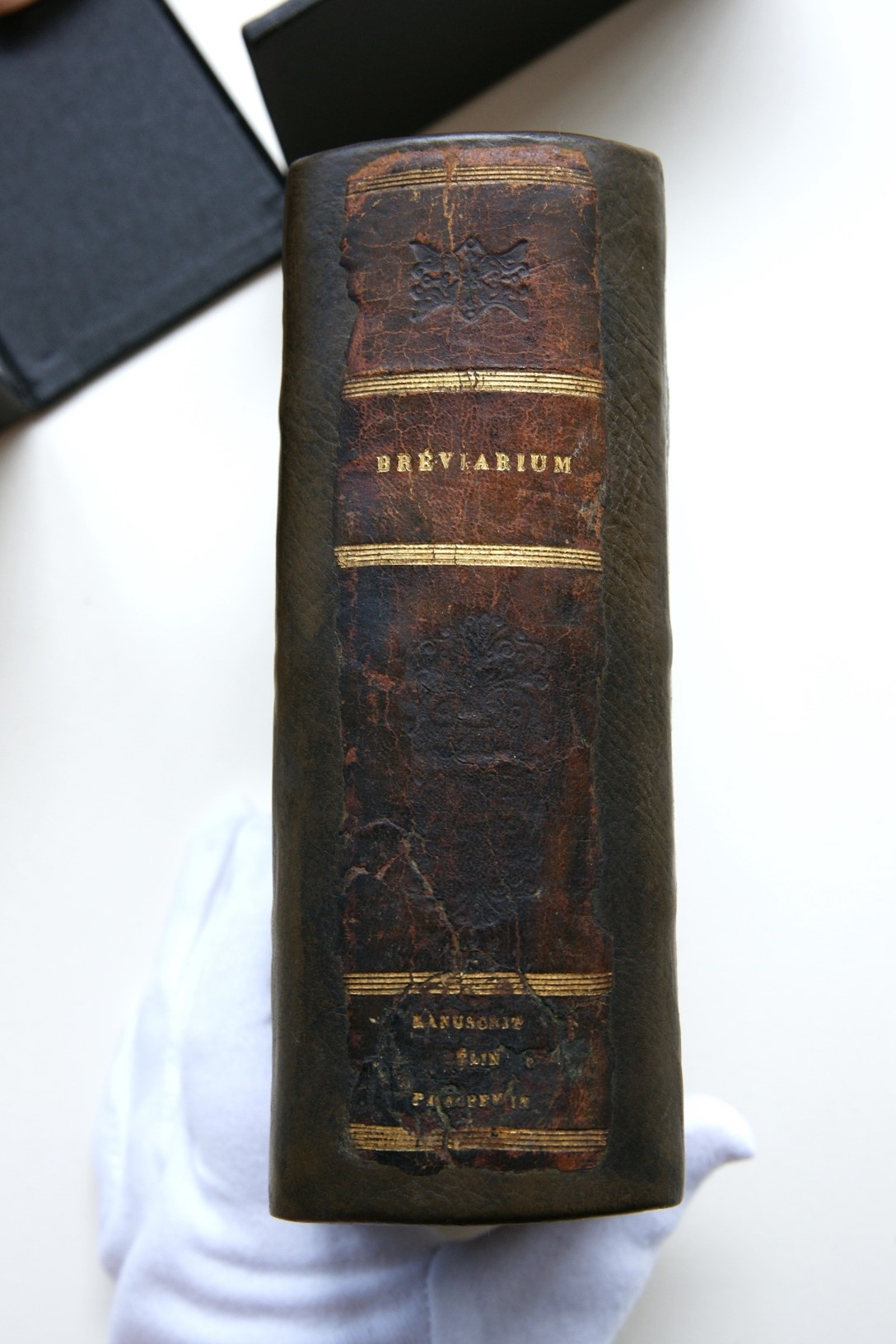
A 13th-century breviary… and a 19th-century binding
A Restoration on a Restoration
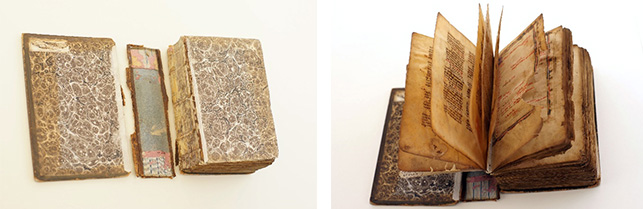
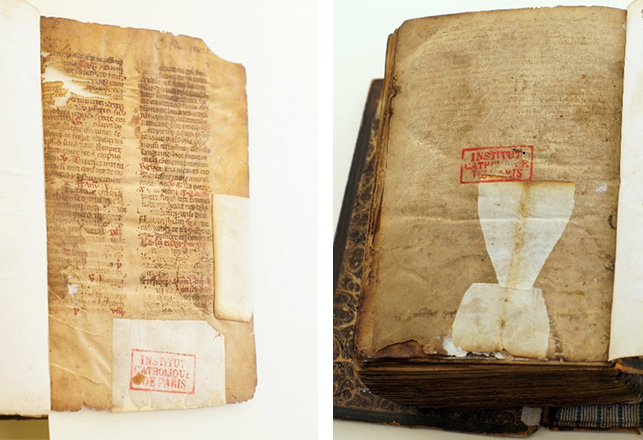
After a thorough examination of its condition, it became very clear to us that this work had already undergone an initial restoration. In addition to its cover, paper reinforcements are particularly visible on the first and last pages. While some of these will be removed during the restoration, this is not the case for all of them. In fact, one particular reinforcement takes the place of a capital letter that has been redrawn by an unknown hand.
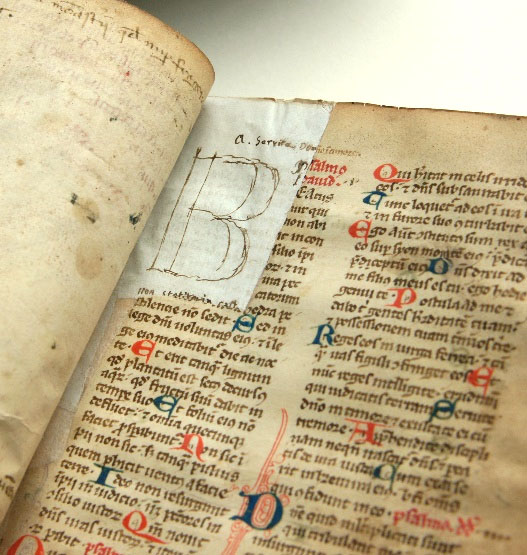
This trace, like others, is now part of the history of this breviary. Therefore, during the treatment proposed by la Reliure du Limousin, it was agreed that this reinforcement should be preserved, as should the most recent cover of the breviary, now considered an original part of the work.
In the workshop, a unique protocol is drawn up to best meet the specific needs of the work.
At the Heart of the Breviary
The first stage of the restoration is undoubtedly the most impressive for the uninitiated: removal of the cover and unstitching. In order to restore each component of the document as effectively as possible, it is essential to dismantle the entire book so that each leaf can be treated individually, as can the two boards. This is especially true since the restoration carried out in the 19th century left behind traces and materials that are dangerous for the parchment.
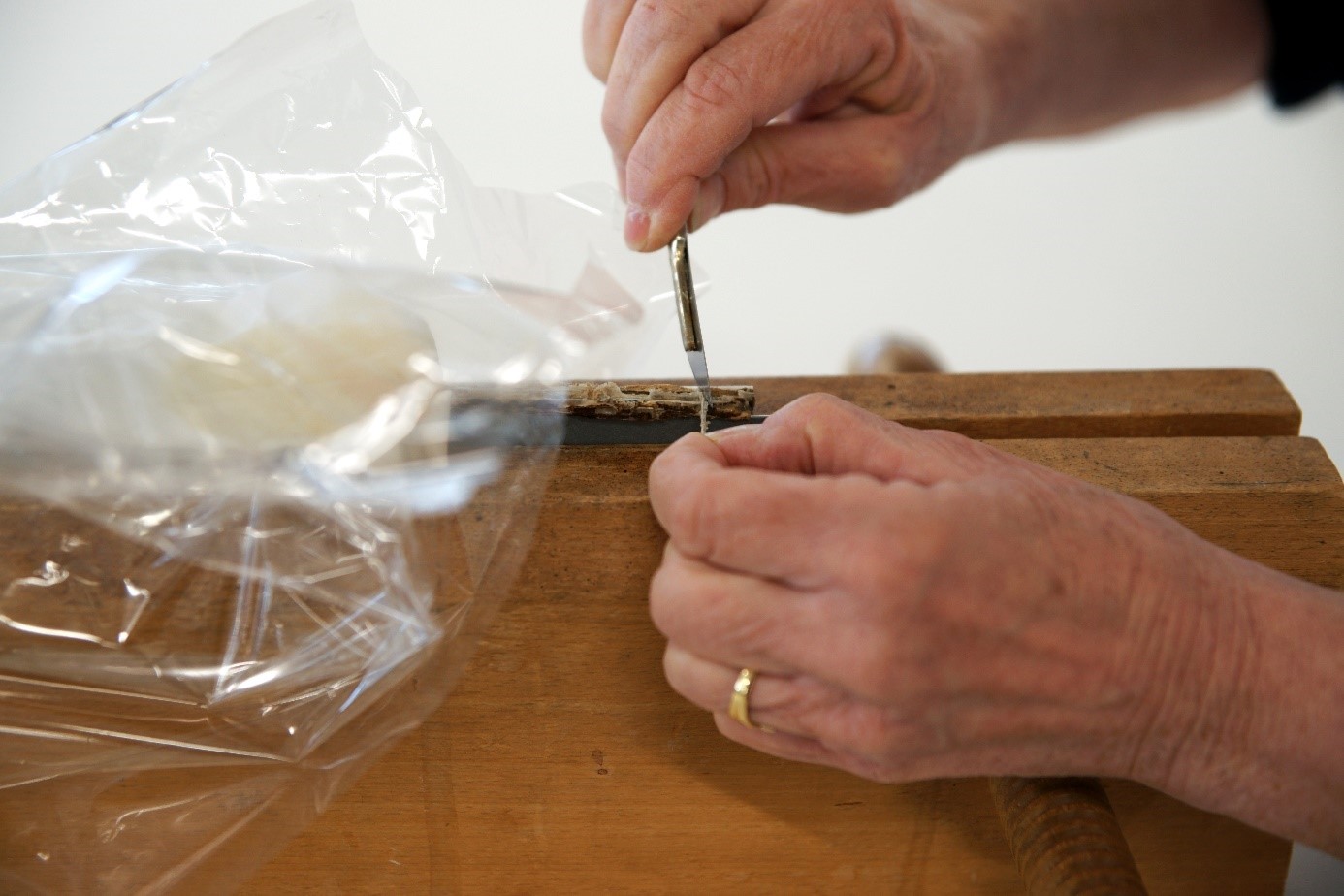
Our analysis revealed that the spine had been coated with a strong, thick glue, similar to modern plastic glue. In order to remove it, the bookblock is held in an ideal and secure position using a gilding press, so that a cataplasm can be applied to the glued area. Controlled relative humidity is provided by Bolloré paper until the original glue is sufficiently softened to be removed, layer by layer, taking care not to damage the 23 signatures contained in the book any more than they already are.
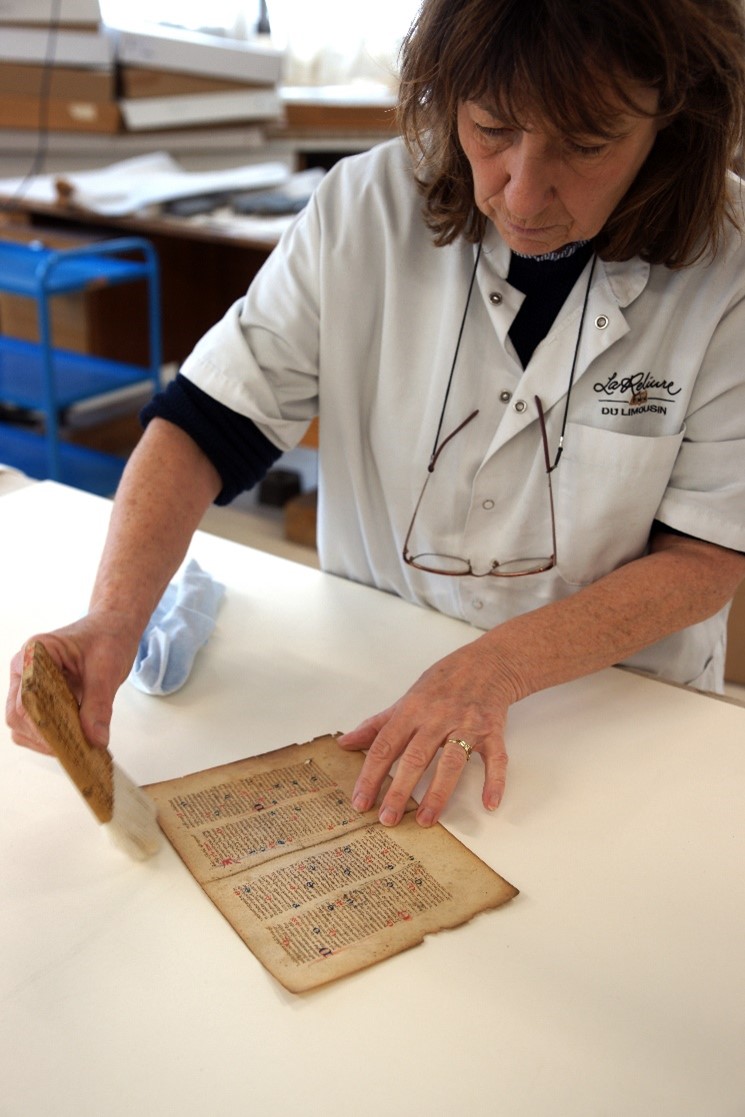
All the leaves can thus be freed. Already foliated and paginated, each leaf is meticulously cleaned. The presence of unsightly reinforcements that are detrimental to both the aesthetics and the integrity of the breviary (due to the acidic glues) forces us to strip them away: these reinforcements, present on the first and last pages, are removed using a new cataplasm. The first reveals a tear, the second a gap.
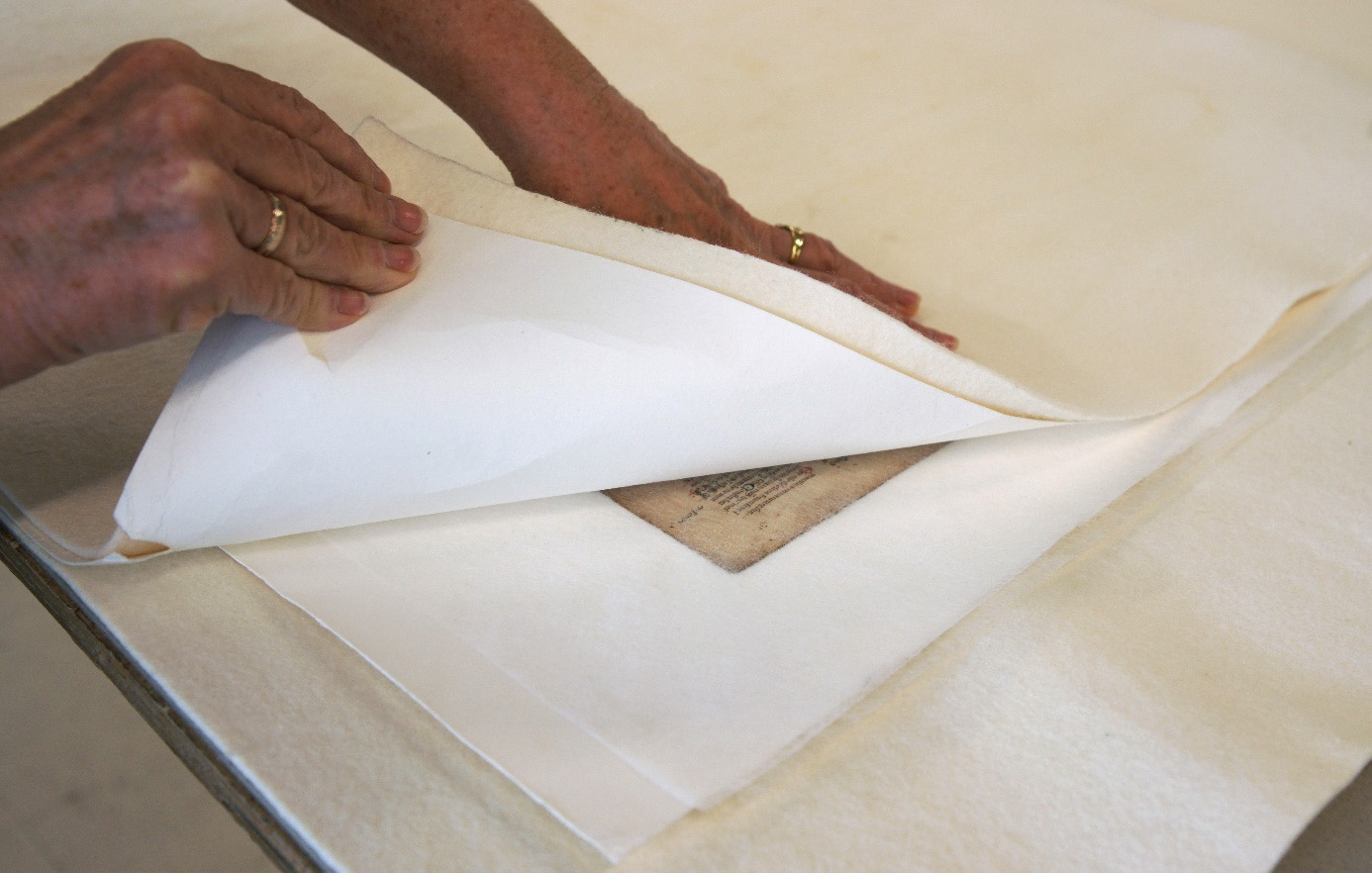
As a living material, the parchment has moved a lot over the years: it has undulations and creases. The pages are placed in a Lascaux chamber, where humidity is gradually and carefully introduced. This technique softens them without posing any risk to the writing. The pages are then laid flat for several weeks to dry at room temperature, between non-woven fabrics, felt, and blotting paper lightly weighted down.
Although parchment is a solid material, it has some fragile areas, including tears and a few gaps. It is therefore reinforced using Japanese paper of different weights and colors to match the color and, above all, the thickness of each parchment sheet as closely as possible. Following several ink stability tests, repairs are carried out using starch glue, so as to ensure that the restoration is completely reversible (see Article 9 of the E.C.C.O.* Code of Ethics). Areas damaged by glue from the previous restoration are also reinforced.
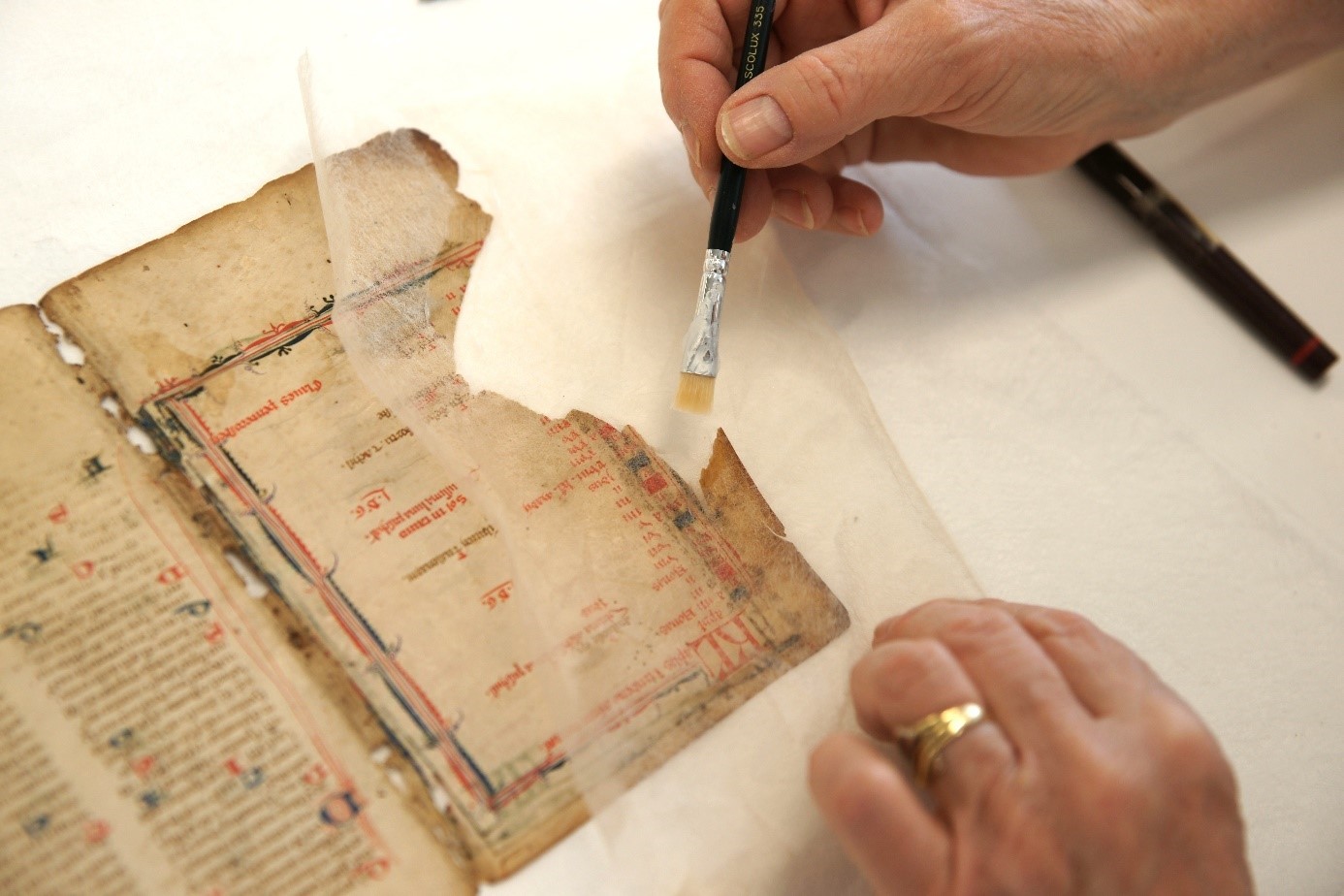
The edges of the Japanese paper are then trimmed, taking care never to touch the parchment, and the sheets are put back in the right order.
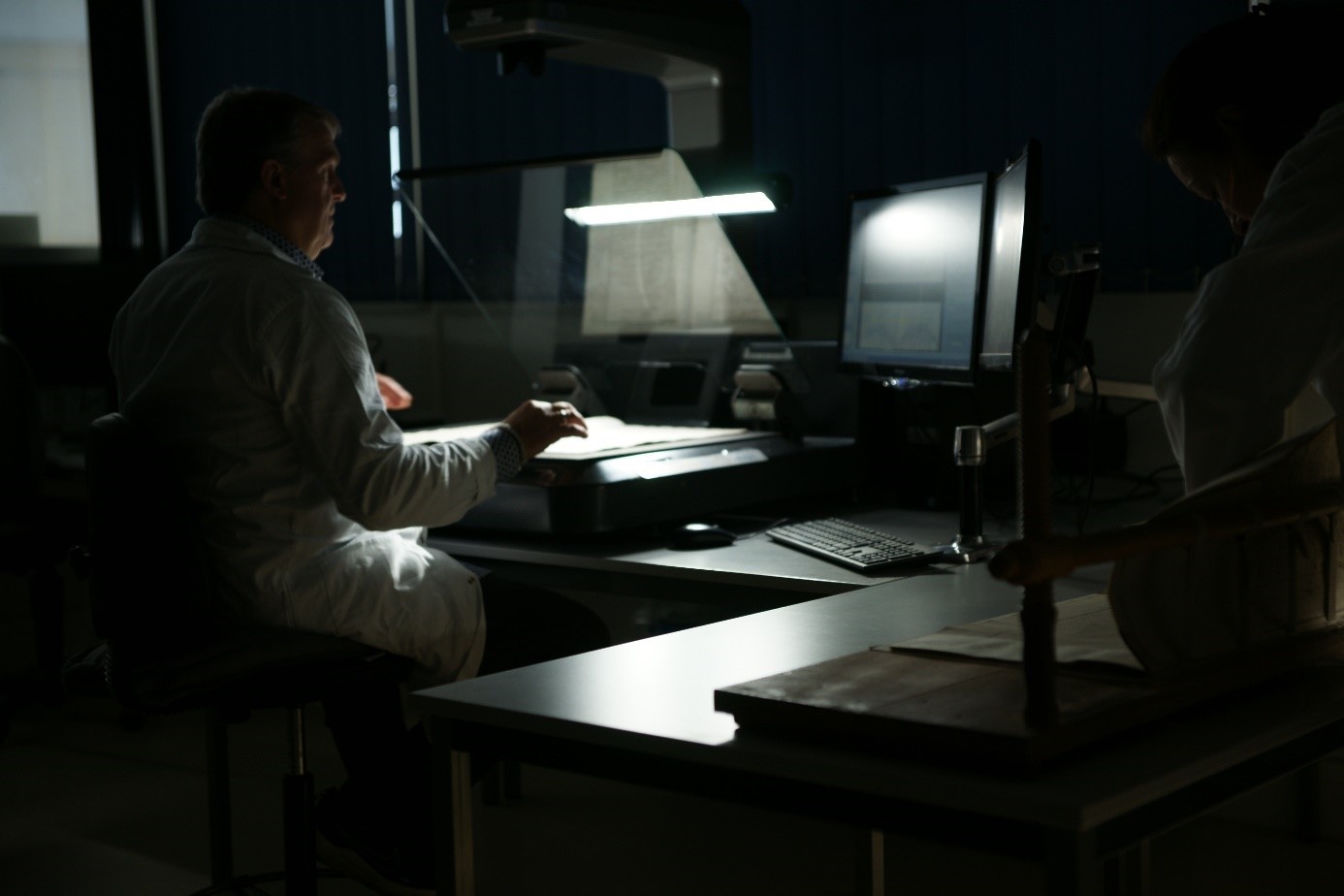
Using heritage scanners that enable digitization in accordance with ISO 19264 standards, Metamorfoze light and FADGI, la Reliure du Limousin then takes care of the heritage digitization of the work: by completely restoring the breviary on our premises, we are able to integrate the digitization directly into the protocol and take 180° photographs before reassembling the pages with the cover. This guarantees optimal access to the writing and superior image quality.
The book is digitized at 400 dpi with particular care taken in the digital reproduction of colors, through the integration of a dedicated colorimetric profile.
The digital images are transmitted in TIFF (preservation) and JPEG (distribution) formats, in order to make the knowledge contained in this exceptional work accessible to as many people as possible.
A Double Case
Once the signatures have been re-sewn with three strings, identical to the original sewing supports, the boards can be reattached after their restoration. This involves filling in the gaps in the covers, which in this case is done using calfskin: using sheepskin is not a viable option, as it does not provide sufficient resistance for conservation. The added leather is therefore dyed to match the color of the original cover, then waxed for perfect protection.
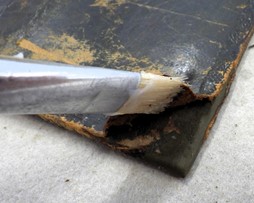
The book can thus be rounded, and the spine prepared. As with the headbands, the original spine, beyond its damage, is now too narrow. A new spine is therefore made of leather and the original spine is re-encrusted using starch glue.
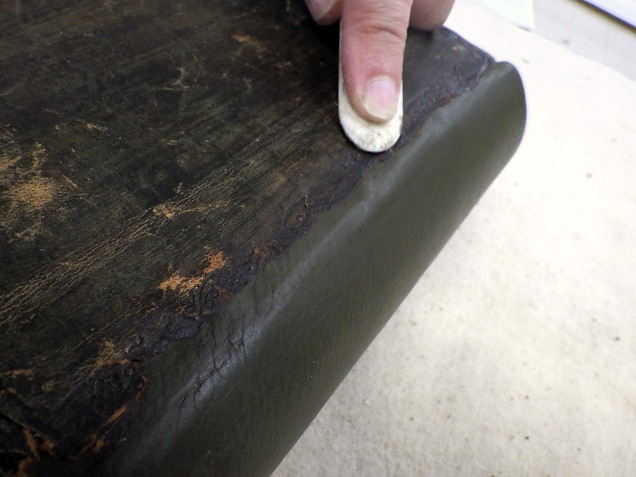
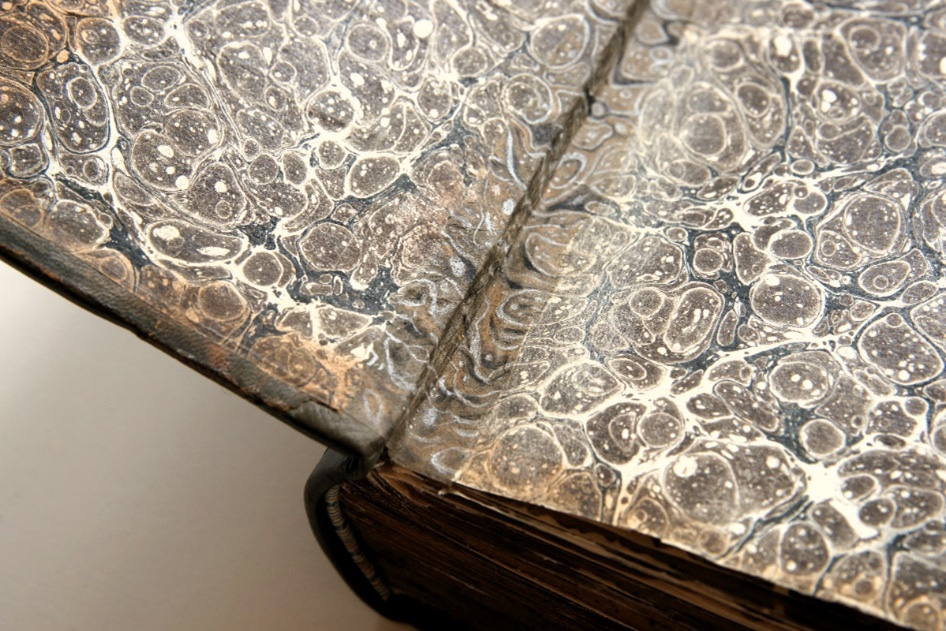
The endpapers, which have also been preserved, are restored with Japanese paper, re-sewn and re-glued into the joint. However, these are not simple endpapers: the marbled paper used is a brown pebbled paper on which the Japanese paper restoration is too visible and does not look very good. Our restorer therefore set about recoloring the consolidation and reproducing the original marbled paper pattern in order to restore the paper’s character, while remaining one shade darker so that the restoration remains visible, albeit discreet.
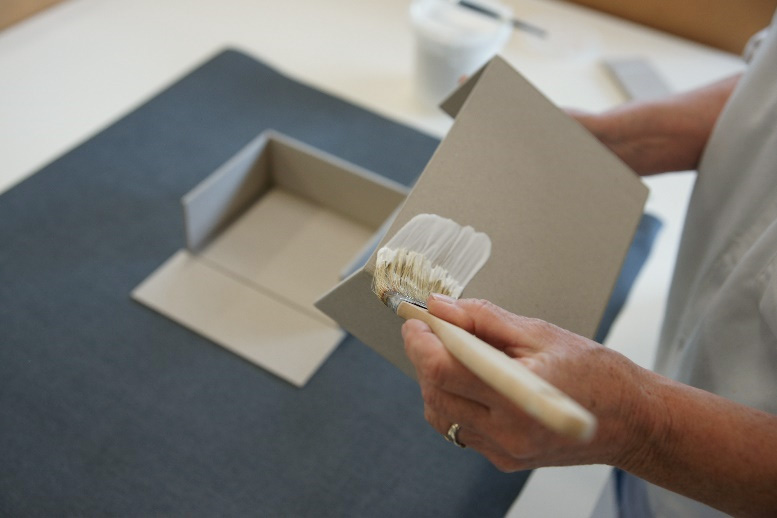
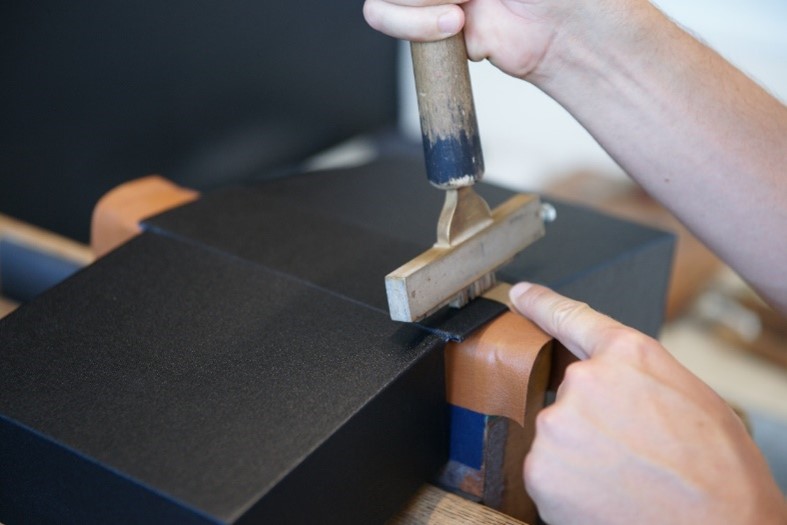
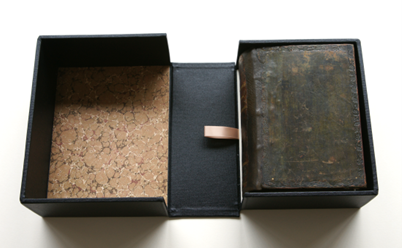
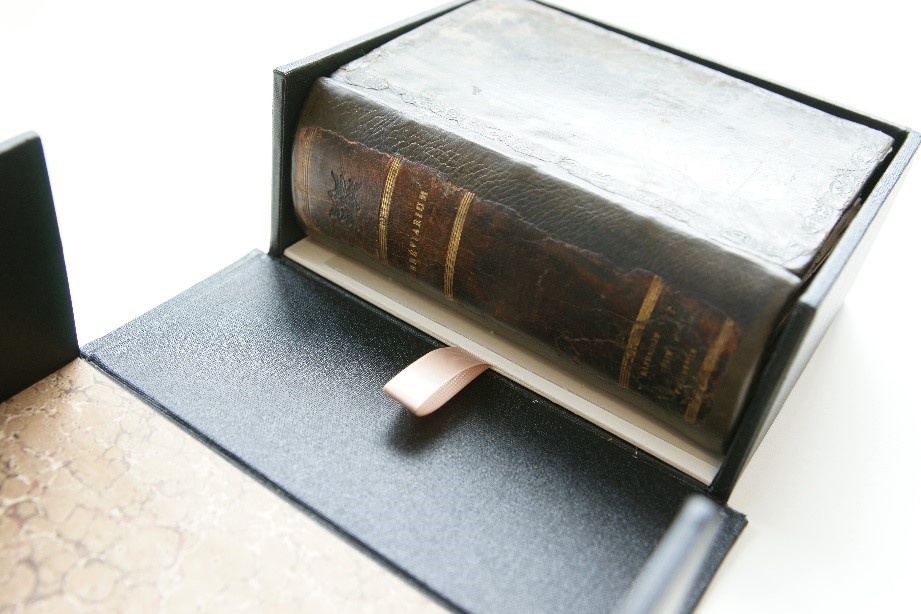
However, a prestigious work deserves more than just a prestigious binding: a new box is therefore made to the exact size of the breviary, using neutral cardboard and covered with black buckram cloth. Custom-made marbled paper decorates the interior, echoing the endpapers of the binding, and a ribbon-adorned grip base is added for easy access to the book. Finally, the registration number, which was previously on a label glued directly to the spine, is transferred to the box using 22-karat gold hot stamping.
Nearly a hundred hours of work have gone into restoring this breviary to its former glory, as well as digitizing it and showcasing it in a manner befitting its prestige.
The La Reliure du Limousin Prize
Since 2023, the La Reliure du Limousin Prize, organized in partnership with Sauvegarde de l’Art Français, has been awarded to a public institution, local authority, or association dedicated to written heritage, enabling it to benefit from the unique expertise of La Reliure du Limousin in order to preserve its collections.
Following a call for applications lasting several months, a specialist jury analyzes the projects and awards the prize, which is presented to the winner at the Salon du Patrimoine heritage fair.
The craftspersons of La Reliure du Limousin then devote all their energy and skills to this project through skills-based sponsorship.
The restored work is then presented the following year at the Heritage Fair.
Applications for the 2024 edition of the prize are still open, so don’t hesitate to send your application to reliuredulimousin@sauvegardeartfrancais.fr.
Are you also involved in heritage conservation? Apply here to benefit from the unique expertise of La Reliure du Limousin. Or contact us for any restoration projects.